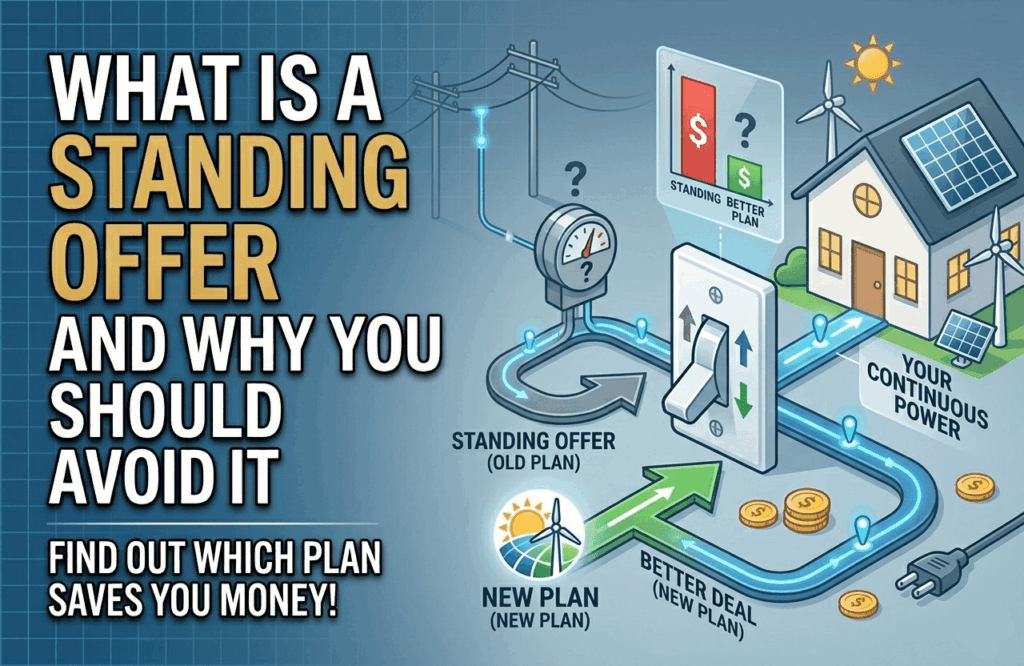

What Is a Standing Offer and Why You Should Avoid It

If you haven’t switched energy providers in the last 12 months, there is a high probability you are paying a “Loyalty Tax.” In the Australian energy market, this happens when you are placed on a Standing Offer.
In 2026, being on a Standing Offer is equivalent to paying full retail price at a store when a 20% discount is available right next door.
Get a budget deal
1. Standing Offers vs. Market Offers: The 2026 Breakdown
Australian energy plans generally fall into two categories. Understanding the difference is the first step toward lowering your utility costs.
- The Standing Offer (The “Safety Net”): This is a basic, no-frills plan. By law, every retailer must offer one. It is regulated by the government and is known as the Default Market Offer (DMO) in NSW, QLD, and SA, or the Victorian Default Offer (VDO) in Victoria. It protects you from extreme price hikes but is rarely the cheapest option.
- The Market Offer (The “Competitive Deal”): These are the plans retailers use to attract new customers. They typically feature lower usage rates, “Welcome Credits” (often $100–$200), and solar incentives.
Why households end up on Standing Offers:
- Automatic Rollover: Your previous 12-month discount expired, and your provider moved you to the default rate.
- Moving House: You moved into a new property and “inherited” the existing connection without selecting a specific plan.
- Inactivity: You haven’t called your provider or compared rates in over two years.
2. The Cost of Inactivity: Why You Should Avoid It
In 2026, the price gap between a “Safety Net” price and a top-tier “Market Offer” is substantial.
- Average Annual Savings: Current 2026 data shows that households switching from a Standing Offer to a competitive Market Offer save between $300 and $450 per year.
- The Reference Price Benchmark: When an ad says “15% less than the Reference Price,” that Reference Price is the Standing Offer. If your bill indicates you are paying at or above this benchmark, you are likely overpaying by hundreds of dollars.
3. How to Spot a Standing Offer on Your Bill
You don’t need to be an expert to identify an overpriced plan. Look for these three “red flags” on your latest statement:
- Plan Names: If your plan includes words like “Standard,” “Default,” “Basic,” or “Standing,” you are likely on the most expensive tier.
- The Comparison Box: By law, your bill must feature a comparison to the Reference Price.
- Red Flag: “Your cost is equal to the Reference Price.” (You are on a Standing Offer).
- Green Flag: “Your cost is 18% less than the Reference Price.” (You are on a Market Offer).
- The “Better Offer” Notification: As of 2026, retailers must include a prominent message if they have a cheaper plan available for your usage profile. If you see: “Could you save money on another plan?”—call them immediately.
Frequently Asked Questions
Is a Standing Offer the same as the Default Market Offer (DMO)?
Yes. In states like NSW, QLD, and SA, the DMO is the “Reference Price” that serves as the cap for Standing Offers. It is designed to be a fair “safety net” for those who don’t shop around, but it is not a “discounted” rate.
Can a retailer charge more than the Standing Offer?
No. Retailers cannot charge residential customers more than the government-set DMO or VDO for a standing offer. However, they can charge significantly less through Market Offers, which is where the savings are found.
Does switching from a Standing Offer involve a credit check?
Most retailers will perform a basic credit check when you sign up for a new Market Offer. If you have a poor credit history, you may be restricted to a Standing Offer, though many retailers in 2026 offer “pre-paid” or “hardship-protected” market plans.