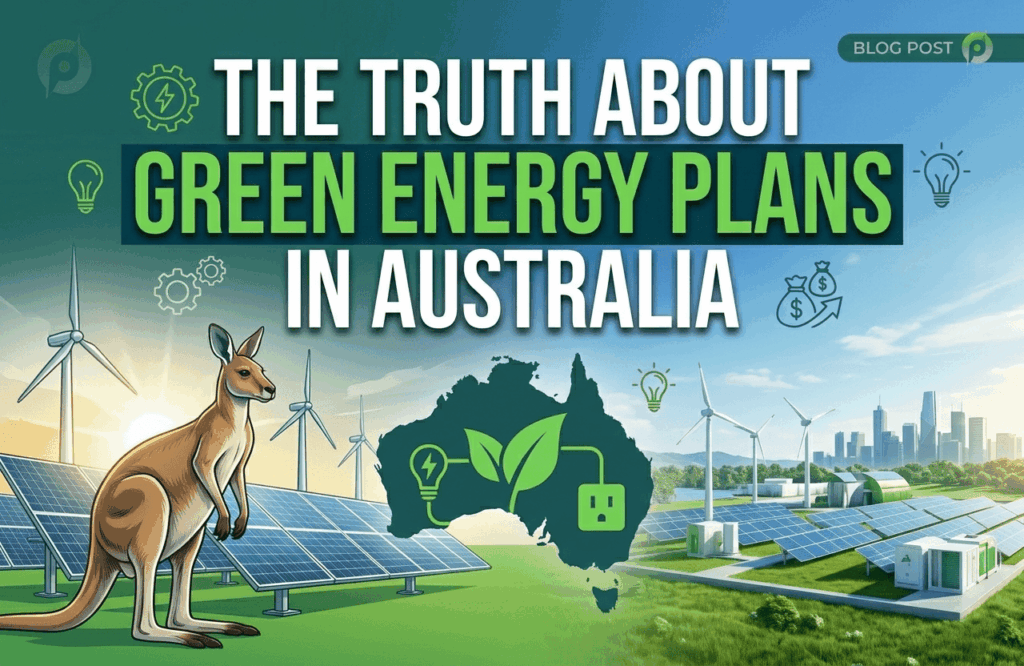

The Truth About Green Energy Plans in Australia

As Australia pushes toward a “Net Zero” future, the energy market has been flooded with green buzzwords. But is your “Carbon Neutral” plan actually helping the planet, or is it just clever marketing?
In 2026, the distinction between a genuinely green retailer and a “greenwashed” one is critical. With new tracking schemes now active, here is the breakdown of what you’re actually paying for.
Get a budget deal
1. What “GreenPower” Means for Your Bill
When you opt for GreenPower, the actual electricity entering your home remains the same mix of solar, wind, and coal as your neighbor’s. However, GreenPower is a government-accredited program that ensures your retailer buys “Large-scale Generation Certificates” (LGCs) to match your usage.
- The 2026 Cost: Despite the spot price for certificates dropping to record lows (around 0.7¢/kWh), most retailers still charge a premium of 3¢ to 5.5¢ per kWh for 100% GreenPower. For an average home, this adds roughly $1 per day to the bill.
- The Benefit: It is the only scheme that guarantees additional renewable energy is added to the grid beyond mandatory government targets.
2. Carbon Neutral vs. GreenPower
This is the most common area of confusion for Australian consumers in 2026.
- Carbon Neutral: The retailer buys “offsets” (like forest protection or carbon capture) to cancel out emissions from coal/gas usage. It doesn’t necessarily mean you used clean energy; it means the damage was “balanced out” elsewhere.
- GreenPower: Your money goes directly into the renewable energy sector to displaced fossil fuels. In 2026, experts consider GreenPower the superior choice for driving systemic change.
3. How to Verify a Retailer’s “Green” Credentials
Don’t just trust the logo. In 2026, use these three “Gold Standard” checks:
- The Greenpeace Green Electricity Guide: The definitive ranking of retailers based on their climate impact. It penalizes “green” brands owned by massive coal-burning parent companies.
- REGO Certificates: The new Renewable Electricity Guarantee of Origin (REGO) scheme launched in late 2025. Look for retailers who use REGOs to prove exactly when and where your power was generated (e.g., “Sourced from NSW Wind at 2 PM”).
- The “Dirty Parent” Test: If your “Green” provider is owned by a company still investing in new gas or coal mines, your profits may still be supporting fossil fuels.
4. Retailer Leaderboard: 2026 Green Rankings
Retailer | 2026 Greenpeace Rating | Best For… |
Diamond Energy | 5 Stars | Those wanting a “Deep Green” specialist that generates more renewable power than its customers use. |
Momentum Energy | 4.5 Stars | Supporting hydro-power; they are 100% owned by Hydro Tasmania. |
Nectr | 4 Stars | Tech-focused homes; won 2026 Mozo Experts Choice for green value in the ACT. |
Amber Electric | 4 Stars | Advanced users who want to shift usage to “real-time” green windows when renewables are cheap. |
Origin / AGL | 1–2 Stars | Customers who want GreenPower add-ons from a major provider while acknowledging the parent company still owns fossil fuel assets. |
Frequently Asked Questions
What is the 2026 Renewable Power Percentage?
The government has set the Renewable Power Percentage (RPP) at 16.67% for 2026. This is the mandatory minimum amount of renewable energy all retailers must source. Choosing GreenPower is an additional voluntary contribution on top of this.
Is “Carbon Neutral” gas real?
“Carbon Neutral” gas typically relies on carbon offsets. In 2026, the Clean Energy Regulator has increased scrutiny on these claims, requiring retailers to prove the quality and permanence of the offsets used.
Can I get GreenPower for free?
Some retailers, like Powershop, occasionally include 100% Carbon Neutral status for free, but 100% GreenPower almost always carries a surcharge to cover the cost of purchasing and retiring LGC certificates.