
Budget Hero

1300 469 061

MON - FRI 9AM-6PM
SAT - 10AM - 5PM

1300 496 061

MON - FRI 9AM-6PM
SAT - 10AM - 5PM

Electricity Rates by State Where Do Australians Pay the Most

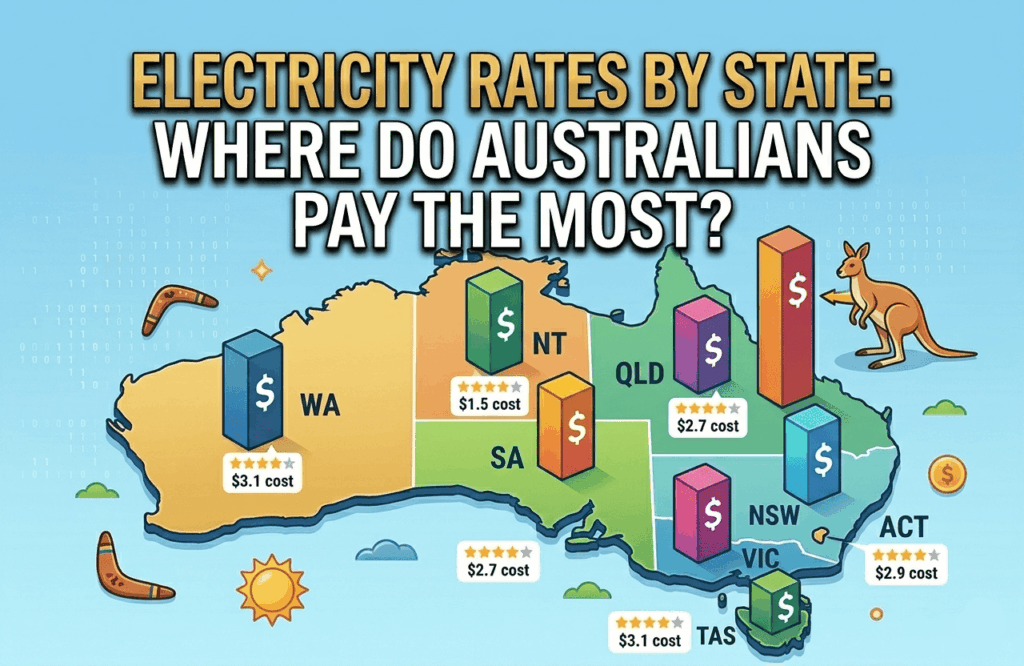
If you’ve ever chatted with an interstate friend about their power bill, you’ve likely noticed a massive price gap. In 2026, your postcode is the single biggest factor determining whether your energy bill is a minor monthly expense or a major financial burden.

As energy markets shift, the “price divide” between states is widening. Here is the 2026 leaderboard for Australian electricity costs.

Get a budget deal

Start Here

1. 2026 State-by-State Leaderboard (Annual Averages)

While your specific bill depends on household size and habits, these figures represent the average annual cost for a typical residential customer in 2026.

State/Region

Average Annual Bill (2026)

Avg. Usage Rate (c/kWh)

New South Wales (NSW)

$1,850 – $2,370

28.5¢

South Australia (SA)

$1,830 – $2,300

43.9¢

Western Australia (WA)

$2,200 (Regulated)

32.3¢

Queensland (SEQ)

$1,750 – $2,140

27.2¢

Victoria (VIC)

$1,620 – $1,680

26.8¢

Tasmania (TAS)

$1,700 – $1,850

~28¢

  • The High-Cost Leaders: NSW and SA remain the most expensive. In SA, usage rates frequently exceed 43¢/kWh, while regional NSW customers (Essential Energy network) often pay some of the highest supply charges in the country.
  • The Middle Ground: WA and QLD sit in the mid-range. WA prices are state-regulated (Synergy Home Plan A1), providing stability but fewer opportunities for competitive discounts compared to the East Coast.
  • The Budget Winners: Victoria remains the most affordable mainland state. A high density of retailers and the Victorian Default Offer (VDO) safety net keep average bills around $1,675, roughly $600 cheaper than an equivalent home in Sydney.

2. Why is South Australia Always the Most Expensive?

It seems a bit unfair—South Australia is a global leader in wind and solar, yet their bills are often the highest. This “SA Tax” is driven by three factors:

  1. Gas “Firming” Costs: When the sun sets and the wind stops, SA relies on expensive gas-fired power stations to maintain the grid. High gas prices in 2026 directly inflate electricity rates.
  2. Isolated Grid: SA is a “cul-de-sac” on the national grid. With limited “interconnectors” to Victoria, they cannot always import enough cheap power from other states during peak demand.
  3. Network Costs: SA has a massive geographical footprint but a small population. This means fewer people are splitting the bill for the thousands of kilometers of poles and wires required to reach regional areas.
  1. Moving Interstate: The “Price Trap”

If you are moving states in 2026, you cannot simply “transfer” your current energy plan.

  • New Distributors: Energy plans are tied to the local distributor (the company that owns the physical wires, like Ausgrid or Energex). Moving states means moving to a completely new network with different cost structures.
  • Regulated vs. Deregulated: If you move from VIC to WA or Regional QLD, you lose the ability to “shop around” as prices are set by the government with only one provider available (Synergy/Horizon or Ergon).
  • Moving Day Opportunity: Moving is the best time to switch. Most 2026 retailers offer “Welcome Credits” of $150 to $200 for new connections. Since you have to disconnect your old power anyway, always compare plans for your new postcode rather than sticking with your old brand.

Frequently Asked Questions

Why are Victoria’s electricity rates lower than NSW?

Victoria benefits from a highly competitive retail market and a shorter distance between power generation (renewables and traditional) and major population centers, which reduces “network losses” and infrastructure costs.

Does the 2026 Energy Bill Relief apply to all states?

Yes. The $150 Federal Energy Bill Relief is a national program. Whether you are in Perth or Hobart, you should see this credit applied to your electricity account (usually in two $75 installments).

Can I get a better rate in WA?

Because the WA market is regulated, you cannot switch retailers. However, you can switch tariffs. For example, moving from the “Home Plan” (flat rate) to the “Midday Saver” can lower your costs if you run appliances during peak solar hours (9 AM – 3 PM).

What Is a Standing Offer and Why You Should Avoid It

What Is a Standing Offer and Why You Should Avoid It If you haven’t switched energy providers in the last 12 months, there is a high probability you are paying a “Loyalty Tax.” In the...
How to Reduce Your Energy Bill Without Buying Anything New

How to Reduce Your Energy Bill Without Buying Anything New In 2026, the cost of living is on everyone’s mind. While ads might tell you to buy “smart” gadgets or expensive solar batteries...
Electricity Rates by State: Where Do Australians Pay the Most?

Electricity Rates by State Where Do Australians Pay the Most If you’ve ever chatted with an interstate friend about their power bill, you’ve likely noticed a massive price gap. In 2026, your postcode...