1. Single Rate Tariffs: The “Set and Forget”
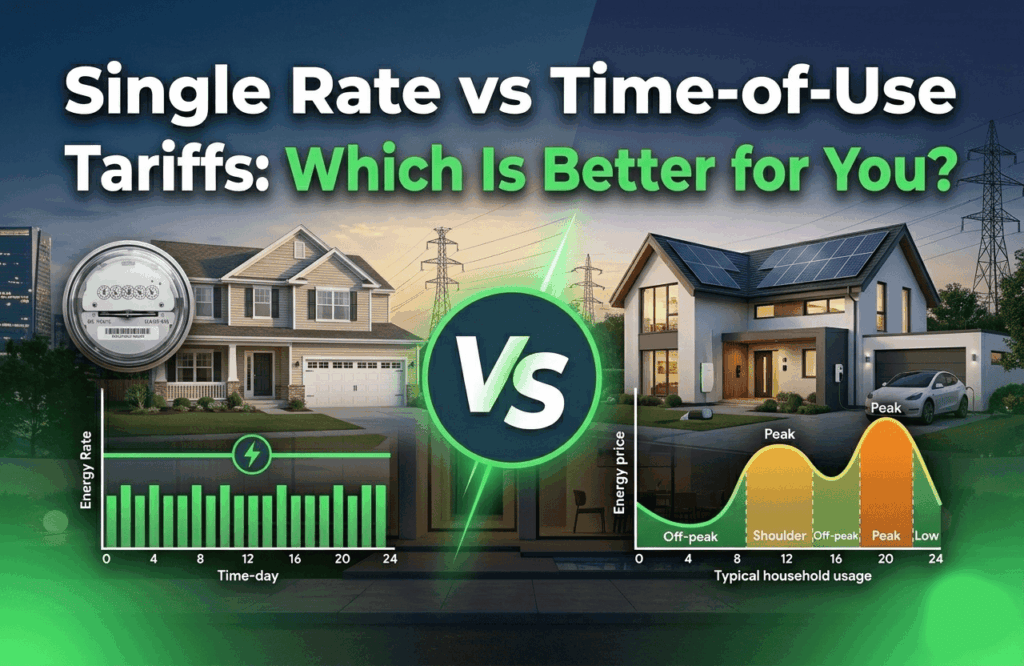
A Single Rate tariff (also called a “Flat Rate”) is simple: you pay the same price for electricity whether you’re boiling the kettle at 6 AM or 6 PM.
- Who it suits best: * The “Homebodies”: If you work from home, are retired, or have young kids, you likely use a lot of power during the day when other plans are at their most expensive.
- The “Non-Shifters”: If you hate the idea of waiting until 10 PM to run the dishwasher, a flat rate protects you from high “Peak” prices.
- The Catch: You don’t get rewarded for being energy-smart. Even if you use all your power in the middle of the night when the grid is quiet, you still pay the full standard price.
2. Time-of-Use (TOU): Mastering the Clock
In 2026, most Australians with a smart meter are moved to TOU plans by default. This plan splits your day into different price zones.
- Peak (The Danger Zone): Usually 3 PM – 9 PM (times vary by state). This is when power is most expensive because demand is highest.
- Off-Peak (The Bargain): Typically 10 PM – 7 AM. This is the cheapest time to use power.
- Shoulder & “Solar Soak”: A 2026 staple! Many regions now have a “Solar Soak” window (often 10 AM – 3 PM) where rates are heavily discounted because solar panels are flooding the grid with cheap energy.
Who it suits best:
- The “Early Birds/Night Owls”: If you can wait until after 9 PM to do laundry or set your dishwasher to run at 11 PM, you’ll save a fortune.
- EV Owners: Charging an electric car overnight on an Off-Peak rate is significantly cheaper than a flat rate.
3. The 2026 Cheat Sheet: Which one wins?
You don’t need a math degree to figure this out. Grab your last bill and check your “Usage Profile.”
If your habits look like this… | Your best bet is… |
You cook dinner at 6 PM, run the heater all evening, and do laundry after work. | Single Rate |
You set appliances to run overnight and use a slow cooker during the day. | Time-of-Use |
You have Solar Panels and use most of your power while the sun is out. | Time-of-Use (to hit the “Solar Soak” rates) |
The “70/30 Rule”: Generally, if you can shift more than 30% of your usage to Off-Peak or Shoulder times (like running the pool pump or dryer during the day), a Time-of-Use plan will almost always be cheaper than a Single Rate plan.
Frequently Asked Questions
Can I switch back to a Single Rate if I have a smart meter?
In most states (NSW, QLD, SA), you can request to be moved back to a Single Rate tariff even with a smart meter. However, in Victoria, many retailers make Time-of-Use the mandatory default for new smart meter installations.
What are the “Solar Soak” hours in 2026?
“Solar Soak” (or Super Off-Peak) varies by network. For example, SA Power Networks and Ausgrid often offer their lowest rates between 10 AM and 3 PM to encourage people to use excess solar energy from the grid.
Does a Time-of-Use plan affect my Solar Feed-in Tariff?
Usually, no. Your “import” tariff (what you pay for power) is separate from your “export” tariff (what you get paid for solar). However, some “Solar Maximiser” plans in 2026 require you to be on a TOU plan to get a higher export rate.