
Budget Hero

1300 469 061

MON - FRI 9AM-6PM
SAT - 10AM - 5PM

1300 496 061

MON - FRI 9AM-6PM
SAT - 10AM - 5PM

Gas vs Electric: What's Cheaper for Australian Homes in 2025?

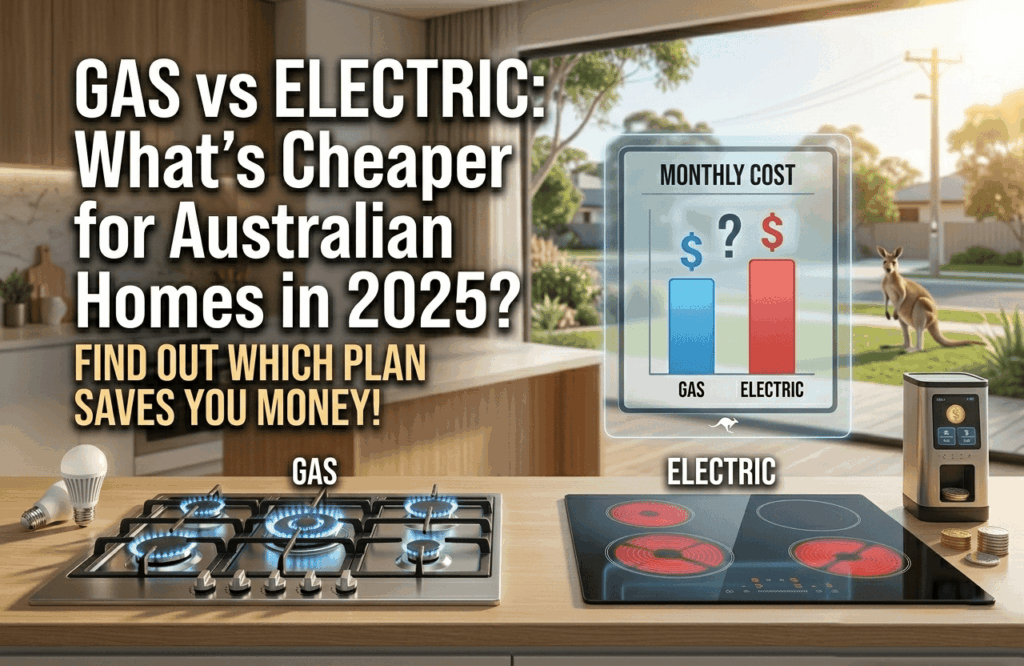
For decades, Australian families were told that “cooking with gas” was the gold standard for speed and savings. But as we move through 2026, the energy script has flipped. With rising gas supply charges and the arrival of super-efficient electric technology, the “all-electric home” has become the primary way to beat the cost-of-living crisis.

Get a budget deal

Start Here

1. Hot Water: The Battle of the Tanks

Hot water is typically the second-biggest energy consumer in an Australian home. In 2026, the technology you choose determines whether you pay $200 or $900 in annual running costs.

  • Gas (Continuous Flow): While popular for “endless” hot water, rising gas prices mean a family of four can now expect to pay $350–$550 per year in usage alone.
  • Electric (Old Storage): The traditional electric resistance tank remains the most expensive option, often costing $600–$900 per year.
  • The 2026 Winner—Heat Pumps: These systems pull heat from the air like a fridge in reverse. They use roughly 75% less energy than standard electric tanks.
    • The Math: Annual running costs are often as low as $200–$350.
    • The Incentive: In 2026, Victorian (VEU) and NSW rebates can slash the upfront cost of a heat pump by $1,000 to $1,900, making the “payback period” shorter than ever.

2. Heating: Gas Ducted vs. Reverse-Cycle

In 2026, efficiency is the only way to combat rising winter bills.

  • Gas Ducted Heating: Common in older Melbourne and Canberra homes, but inherently inefficient. You lose significant heat through ducts, and for every $1 spent on gas, you get less than $1 of heat.
  • The 2026 Winner—Reverse-Cycle Air Con: Your “split system” is the most efficient heater available. Modern units provide $3 to $5 of heat for every $1 of electricity used. If you have solar panels, running these during the day can make your winter heating effectively free.

3. The “Hidden” Savings: Daily Supply Charges

One of the most immediate benefits of “getting off gas” isn’t the usage—it’s the connection fee.

  • The Double-Charge Trap: If you use both gas and electricity, you pay two separate daily supply charges.
  • The Cost: In 2026, gas supply charges average $0.80 to $1.20 per day.
  • The Instant Fix: By disconnecting from the gas network entirely, you save roughly $300–$400 a year before you even turn on a single appliance.

4. State-by-State: The 2026 Transition Rules

State

Status & Strategy

Victoria

Aggressive Transition: From March 2027, failed gas hot water systems must be replaced with electric. 2026 is the best year to use VEU rebates to switch on your own terms.

ACT

Gas-Free Mission: The ACT aims to be gas-free by 2045. New gas connections are already banned in most residential areas. Going all-electric is now the local building standard.

NSW & QLD

Solar Synergy: While no bans are in place, the high solar uptake in these states makes electric heat pumps the logical choice. Using “free” solar to heat water and air is the ultimate 2026 savings hack.

Frequently Asked Questions

Is induction cooking better than gas in 2026?

Yes. Induction cooktops are faster, safer, and easier to clean. More importantly, they allow you to disconnect from the gas grid entirely, saving you the ~$300 annual daily supply charge.

How much can I save by switching from gas to all-electric?

A typical Australian household can save between $1,000 and $1,500 per year by switching to an all-electric setup (Heat Pump hot water, Reverse-Cycle heating, and Induction cooking), especially when paired with a modest solar system.

Does the government pay for me to switch to electric?

While not “free,” substantial rebates exist in 2026. Programs like the Victorian Energy Upgrades (VEU) and various NSW energy savings schemes provide significant discounts on heat pumps and air conditioning upgrades.

What Is a Standing Offer and Why You Should Avoid It

What Is a Standing Offer and Why You Should Avoid It If you haven’t switched energy providers in the last 12 months, there is a high probability you are paying a “Loyalty Tax.” In the...

How to Reduce Your Energy Bill Without Buying Anything New

How to Reduce Your Energy Bill Without Buying Anything New In 2026, the cost of living is on everyone’s mind. While ads might tell you to buy “smart” gadgets or expensive solar batteries...

Electricity Rates by State: Where Do Australians Pay the Most?

Electricity Rates by State Where Do Australians Pay the Most If you’ve ever chatted with an interstate friend about their power bill, you’ve likely noticed a massive price gap. In 2026, your postcode...